Thursday, November 25, 2010

Tokyo Big 6 Fall 2010 Best Nine, Stats Stuff, New Captains, etc

I've been really remiss in my Big 6 posting, but the final week was kind of traumatic for me for various reasons. As I mentioned before, Keio had to sweep both games of Keisousen/Soukeisen, which they did, and then win another forced playoff game -- the first Waseda-Keio playoff game in 50 years -- on November 3rd to take the title away from Waseda.

As you can probably guess, especially since I mentioned that Waseda was playing in the Jingu Taikai, that didn't happen. Daisuke Takeuchi had a pretty tough 1st inning and Waseda took a quick 3-0 lead, which extended to 7-0; Yuki Saitoh pitched SEVEN INNINGS OF NO-HIT BALL before imploding in the 8th and Keio scored 5 runs to bring it to 7-5. Ohishi finished out the game for Waseda, and so IMO, rather than trying to win it, Etoh-kantoku put in lefty Takuya Masaki to pitch the 9th inning with Ryuta Iba as catcher. Masaki and Iba were a battery at Keio high school, YEARS ago, so it was a "last moment" for them. I'm not sure Masaki ever pitched in college, he always played 1st base when I saw him.

So Waseda won 10-5 and won the Fall 2010 Championship. The reporters and photographers had a total party with this one, of course, and so many cameramen were set up that normal people couldn't even SEE the doage where they tossed Saitoh and everyone up in the air.

There was a Fall 2010 Closing Ceremony after that where all the teams came out and lined up, they presented Best Nines and trophies for ERA and batting champ. I sat right behind home plate for that part. I should have gone outside to say a final goodbye to some players from the other colleges, and wanted to say a congrats to Kagami, but instead I ended up at the Keio retirement ceremony, held inside Jingu. At least I got to say goodbye to my favorite Keio boys afterwards (except Daisuke, who was nowhere to be found). Still, it was a really long emotional day for a lot of people; lots of players were crying, and even I was crying a few times, since it was ostensibly my last Big 6 game for a very long time, and I'm going to miss everyone a lot.

Anyway, on that note, let me post some season-summarizing stuff:

Best Nine
Pos Name College Yr. Votes Times High School

P Koji Fukutani Keio 2 12 1 Yokosuka
C Masahiro Nagasaki Keio 4 15 3 Koshi
1B Sho Nishi Meiji 4 17 1 Toho
2B Koji Udaka Waseda 4 15 1 Imabari Nishi
SS Hitoshi Fuchigami Keio 4 20 1 Keio
3B Kanji Kawai Hosei 1 20 1 Chukyodai Chukyo
OF Hayata Itoh Keio 3 17 2 Chukyodai Chukyo
OF Shohei Habu Waseda 3 19 2 Koryo
OF Toshiki Yamada Waseda 4 16 2 Waseda Jitsugyo

Full votes is 22. Oddly, nobody got full votes. It really was kind of a difficult season to call, in many ways, especially with the craziness at the end. What is odd is that usually the position players for Best Nine are the best batters at each position, but that didn't quite happen this time, because if it had, Soichiro Tanaka should have had an OF Best Nine. (And in all honesty he should have had one anyway -- my picks would have been Shohei Habu, Soichiro Tanaka, and Hayata Itoh, both for their batting AND fielding.)

I hate to say this about Masahiro Nagasaki, since I'm a huge fan of his -- he is a pretty good all-around catcher, but his arm is pretty weak. He handles pitchers well, he fields fouls really well, and he certainly bats better than most other catchers (though Hosei's Takuya Hiromoto was the best catcher both in AVG and OPS this semester). But a lot of the other catchers have stronger arms and are better at actually holding runners. (Nagasaki told me he's quitting baseball after college, so I guess it's irrelevant now anyway.) I foresee a battle between Daisuke Ichimaru (Waseda) and Kenji Kawabe (Meiji) for the Best Nines next year.

I think Hosei's Hiroshi Taki was probably robbed of a Best Nine due to starting the season at SS and playing the last few series at 1B. Meiji's 1B Sho Nishi got the Best Nine due to his huge batting average, which was COMPLETELY due to going 6-for-6 with two walks against Todai during their first series. Nishi was 9-for-13 (.692) in the first two series, and then 5-for-28 (.178) in the last 3 series. Without the Todai games, Nishi batted a pedestrian .228 for the season. However, Taki actually saw his average DROP in a two-game series against Todai where Yoshihiro Maeda was going all out for his final two games EVER, hoping for just ONE win against his 23 losses, and really threw the best games I'd ever seen him pitch in his Todai career. Taki batted .350 in games NOT involving Todai. Take that as you will. (Or more like, give him the Best Nine, dammit!)

I'm happy to see Fukutani get the Best Nine, because he is awesome. He's tall (182cm), smart (was a top student in HS and aced the Keio entrance exam), humble and sweet ("You sure you want me to ruin this nice photo by writing my name on it?"), and can throw 95mph. It's clear that he barely got a majority of the Best Nine votes (12 of 22) and I am guessing a lot of the others went to Yusuke Nomura, with perhaps a few going to Kisho Kagami as well. These people tend to vote based on wins and ERA alone, which would give you those 3 guys tying for the league lead of 5 wins:

W L ERA IP ER
Nomura 5 2 1.30 55.1 8
Fukutani 5 1 1.32 61.1 9
Kagami 5 3 2.31 62.1 16

So I'm guessing that Kagami was out based on his "high" ERA, despite how he essentially carried Hosei on his back -- he had more innings pitched than anyone in Big 6. On the other hand, Kagami gave up more home runs (4) than any other pitcher in Big 6 except for his teammate Kazuki Mishima. Whoops.

Fukutani probably got a few more votes than Nomura because Keio did better than Meiji, and Fukutani pitched in some REALLY key situations and did well, including basically getting a win AND a save in the 2-game Keio-Waseda series. If Fukutani had managed one more scoreless inning, he would have had the league ERA title, actually (it's that close -- 9 runs on 62.1 innings slightly edges out 8 runs in 55.1 innings).

But, if you look at Nomura vs. Fukutani by stats that "matter", it becomes a slightly different story...

IP H HR BBH WHIP BF K/BF BB/BF H/BF
Fukutani 61.1 43 0 19 1.01 237 18.1% 8.02% 18.1%
Nomura 55.1 48 0 8 1.01 216 25.0% 3.70% 22.2%


There are only two guys in Big 6 with enough IP to qualify who beat Nomura's strikeout percentage. One is Tatsuya Ohishi, who ALWAYS posts the best K/BF rate in the league. The other is Yuya Fukui, who usually quietly has some great strikeout rates AND some lousy walk rates. And both of those guys were drafted last month.

Nomura easily has the best BB/BF percentage in the league. The next best is Kagami's 4.88%. Nomura simply does not walk batters or give up home runs to them. By the defense-independent breed of statistics, Nomura is just the best in the league, and has been for most of his college career.

On the other hand, Nomura got a lovely trophy for the ERA title anyway, so hey, give this to Fukutani. He deserves something for being awesome too, just like Daisuke did in the spring.

Batting and ERA champs

Koryo class of 2007 in the house!

Batting champion: Shohei Habu, Waseda, .386/.472/.523
ERA champion: Yusuke Nomura, Meiji, 5-2, 1.30

These guys, who were high school teammates that came two innings from winning Koshien together in 2007, are only going to get better next year. Watch out for them. I nicknamed Shohei Habu "Habunnai", a pun on the Japanese word "abunnai" which means dangerous, because when you cheer against Waseda, he's a guy you don't look forward to seeing at the plate.

Other "Relevant" Stats
I realize that 11-13 games and 50ish plate appearances are not a huge sample size, but well, that's what you get in a season here.

Top 10 Batters by OPS:

(W3) Shohei Habu .386/.472/.523 .994
(K3) Hayata Itoh .315/.406/.556 .962
(R4) Soichiro Tanaka .327/.448/.473 .920
(M4) Sho Nishi .341/.438/.463 .901
(H3) Yusuke Hasegawa .278/.395/.500 .895
(W4) Toshiki Yamada .371/.436/.457 .893
(R4) Yuki Maeda .268/.380/.488 .868
(H1) Kanji Kawai .350/.356/.500 .856
(H2) Hiroshi Taki .319/.418/.426 .844
(W4) Koji Udaka .343/.372/.457 .829
(K4) Hitoshi Fuchigami .362/.415/.414 .829

Astute readers may notice there are 11 names in this list because both Udaka and Fuchigami were tied for 10th.

This time there were no crazy guys with an OPS over 1.000, sadly, but it was interesting nonetheless.

Keio's Hayata Itoh and Rikkio's Yuki Maeda tied for the league lead for homeruns with 3 apiece. Itoh also leads the league in RBIs with 11.

Rikkio's Soichiro Tanaka and Koichiro Matsumoto tied for the league lead for walks with 12 apiece.

(Interestingly, Meiji's Katsuya Kawashima was next in walks with 10, but didn't have enough PA to qualify for the batting title lists; he walked those 10 times in 28 PA. His line for the semester is a BIZARRE .167/.464/.222; I wonder how he'll do if they give him the leadoff spot regularly next year.)

Hosei's incumbent captain Masashi Nanba is the stolen base leader with 7.

Team batting:

HR SB E
Keio .264/.317/.390 .707 10 13 8
Waseda .268/.328/.341 .669 5 7 6
Hosei .262/.315/.351 .666 5 16 6
Meiji .255/.325/.323 .648 3 14 9
Rikkio .241/.307/.329 .636 8 13 12
Tokyo .169/.231/.187 .418 0 4 17

League avg .243/.304/.320 .624 5.2 11.2 9.7

Nothing weird in the patterns this semester. What's kind of sad is how truly awful Todai was at batting -- they were 55-for-326 as a team, with a whopping SIX extra-base hits. SIX. All doubles.

Team pitching:

ERA WHIP K/9 BB/9
Keio 1.96 1.13 6.70 3.05
Hosei 2.44 1.12 7.48 2.36
Waseda 2.69 1.13 8.16 3.87
Rikkio 3.12 1.32 5.86 4.12
Meiji 3.19 1.21 7.63 2.96
Todai 6.41 1.95 2.97 5.74

Hosei's pitching looks really great on paper, especially since Kazuki Mishima got his walks down a lot this semester. If only he and Kagami hadn't given up so many home runs...

Naturally, Waseda has the highest strikeout ratio, being as they've got a lot of power pitchers and 97% of their innings went to the Big Three of Saitoh, Ohishi, and Fukui anyway. (Not a joke. 103 of the 107 innings pitched by Waseda staff were by those three.)

BTW, one more run in the realm of Small Sample Size Theater:

RS RA G W/L/T Pythag W-L
Waseda 45 33 12 8-4 8-4 .638%
Keio 63 33 14 8-4-2 11-3 .766%
Hosei 57 33 13 8-4-1 9-4 .731%
Meiji 48 45 13 7-6 7-6 .529%
Rikkio 52 54 15 4-8-3 7-8 .483%
Tokyo 13 80 11 1-10 0-11 .034%

I thought this was weird because the top three teams all allowed exactly 33 runs. What's up with that? No, but seriously, it was also curious that the Pythagorean win/loss tagged a lot of teams pretty closely minus ties, except Keio; though to be fair, Hosei was the benefactor of a 23-3 weekend vs. Todai, and Keio had a 19-0 weekend against Todai; no other team had a double digit game against them, oddly.

The lesson to be learned? Slamming Todai gets you nowhere! Losing to them is the key to success! Making history by almost forcing a first-ever 6-game series due to ties and then actually forcing a 1-game playoff later on will never win you a championship, Keio!

Just kidding.

Anyway, since every team EXCEPT Waseda has decided their next captain...

2011 Team Captains!

Keio: Hayata Itoh OF, Chukyodai Chukyo HS
Meiji: Ikuhiro Takeda IF, Hotoku Gakuen HS
Hosei: Masashi Nanba IF, Chukyodai Chukyo HS
Rikkio: Keisuke Okazaki IF, PL Gakuen HS
Todai: Shuhei Iwasaki IF, Kaijo HS

What's kind of cool is that I've actually met all of these guys at least once, and even have photos with or autographs from most of them. I guarantee I have not met whoever Waseda chooses (what do you want to bet it'll be Ayuki Matsumoto?)

Also, no pitchers. I'm of the opinion that the best team captains are often middle infielders or catchers. Pitchers have more than enough to worry about without the additional responsibilities of being a team captain, honestly.

And on an outgoing note, I kept forgetting to share this, so here is as good a place as any. Seiya Ohyagi, the outgoing Hosei captain, wrote a long and touching blog entry right before Soukeisen saying how he's known the Waseda 3rd-base coach Shoji "Bob" Nozaki since they were in middle school, and for one reason or another they never got to play baseball together again after that time, but had stayed in touch through HS and college rivalries, and he was sad to learn that Nozaki had given up playing and was coaching and rookie-managing instead, but felt that his old friend still looked "cool" out there anyway, and wanted to cheer for him at Soukeisen. And at the end of the post he put a photo of himself holding a "Seiya loves Nozaki" drawing. Very cute.

So a day or two later, on the never-updated Waseda blog, Nozaki wrote a response, basically saying the same thing -- that all of these years of their supposed rivalry didn't change that they were still Best Baseball Buddies Forever.

It was just very sweet and very Seiya. I think I'm kind of being unfair to Nanba in that there's no way he can live up to the way I saw Ohyagi out there on the field and before and after games as a leader and a representative of the team.

And another one of my favorite captains, Keio's Tatsushi Yumoto, also just wrote a farewell post on the Keio blog. The last time I saw Yumoto was on his birthday... which was that final playoff game on November 3rd, that Keio lost to lose the championship. Poor guy.

On a final note, the fall issue of 大学野球 is out TODAY! and has a ton of interesting stuff in it, including the usual list of which companies players are heading to next year. I'll try to put that up sometime when I have a chance.

Tuesday, November 23, 2010

Jingu Taikai, Sunday, Games 2-3

Well, when I STARTED writing this, the Jingu Taikai tournament was finishing up the finals. The high school final match was Kagoshima Jitsugyo High School, aka "Kajitsu", against The Third Senior High School Of Nihon University, aka Nichidai San or just "Sanko". The university final match was Waseda vs. Tokai. And Sanko beat Kajitsu 4-1 and Waseda beat Tokaidai in a heartbreaking 2-1 game, so Sanko and Waseda are your champs. The media already had a field day with the Yuki Saitoh stuff, and now maybe he can finally get around to signing with the Fighters.

I'm not sure why the Jingu Taikai has both high school and college in the same tournament, but it makes for some really interesting days at Jingu where you can see some of the finest players in both levels of play. Each day they have 4 games, with 2 high school games in the morning and 2 college games in the afternoon, and if you buy a ticket for the day, you can sit for all 4 matches if you so desire.


The only problem is that it starts on Saturday and goes until Wednesday, so only the first two days are weekend days; the other days I'm checking the scores on my computer at school between classes and meeting some of my 9th-grade boys in the hallway to feed them contraband information like how many batters Tatsuya Ohishi struck out.

Anyway, so Saturday November 14th, I went down to Jingu for the second game of the tournament. My actual motivation for going was to see Sanko's team and specifically right-handed pitcher Kentaro Yoshinaga, who I've been following along with some of my students, but had never seen in person thanks to the rainouts at Senbatsu and a scheduling snafu during the Tokyo summer tournaments.

Sanko vs. Hokkai was the second game of the day, scheduled to start at 11am, which is when I arrived. Unfortunately, due to Game 1 of the day, Ogaki Nichidai knocking out Tenri 2-1, taking only 1 hour and 43 minutes, Game 2 actually started at 10:45am, so it was already the bottom of the 2nd inning when I arrived. Fortunately, I could get the box scores off Sanko's website and find out what I missed later. (It was only two walks, anyway.)

The stadium was already pretty full when I got there, and I'd guess that fully half of the people in the stands were other high school or college students, with the other half being a mixture of friends/family of the teams, and the usual suspects that make up the college games, ie, housewives who love Yuki Saitoh, and old men who have nothing better to do than come to Jingu and drink beer and yell at young boys playing baseball. Naturally the front area I usually sit in was taken up by high school students on my side -- Sanko's cheering section -- and by tons of towels that were seatholders for Waseda's game on the other side. I am not sure that Hokkai actually really brought a cheering section down from Hokkaido, to be honest.


(Nichidai Sanko's ouendan -- they scored a run in the middle of me filming this, so you can even see them singing the school song.)

I sat about 2/3 of the way up the stands, behind the Sanko dugout, basically, and kept score, watched the cheering, and didn't have my big camera for a change. The only shame about that was that I didn't get to take any good pictures of Yoshinaga-kun, who was the main reason I wanted to see the game.

(And in short: He is GOOD. We saw him hit upwards of 147km/h on the Jingu gun with his fastball, but he also threw a bunch of other stuff as well... and he literally allowed 4 runners all game, not even allowing his first hit until the 5th inning. And that for a sophomore who is already 6' tall!)

Right after I arrived, in the top of the 3rd inning, Sanko's catcher Takahiro Suzuki was hit by a pitch, and then leadoff rightfielder Shun Takayama followed that up with a home run to right field! That made it 2-0.

But then things settled down for a while. Hokkai's starter was a freshman named Shoichi Tamakuma -- he wasn't nearly as overpowering as Yoshinaga, and the highest speed he was getting was maybe 134ish. Also, his control was iffy and he walked like 4 guys over the course of 8 innings (and hit two more), so there was a Sanko runner on base EVERY inning pretty much. But somehow for the next 3 innings, despite 6 runners, Sanko scored no runs, including leaving the bases loaded in the 6th.

Top of the 7th, Suzuki led off with a legitimate double to left (I say legitimate because at the HS level you often get "doubles" and "triples" that are really just "this dude will learn to judge the ball a lot better with time" problems). Takayama popped out to left, and so Yuta Taniguchi tried to bunt up Suzuki, but the Hokkai pitcher made an awkward grab and throw to field the bunt, and so both runners were safe at the corners. Sho Asegami singled to right to bring home Suzuki; 3-0, and Toshitake Yokoo singled to bring home Taniguchi, 4-0, before Ryoya Kaneko grounded into a double play.

Hokkai put one run on their side through a big mistake by the Sanko battery; two runners in a row had singled and so there were runners at 1st and 2nd when Yoshinaga threw a wild pitch that Suzuki couldn't block. But for whatever reason, they kind of stalled on actually GETTING the ball back, long enough that runner Tama was able to score from second base on the wild pitch. Pretty nuts. 4-1.

Koki Shimizu led off the top of the 8th with a double to right, and then Kenichi Suganuma sac bunted... and Hokkai pitcher Tamakuma fielded and threw the ball over first base, with Shimizu scoring on the play, 5-1. Pitcher Yoshinaga grounded into a double play after that.

Back to the top for the top of the 9th, though, where home-run hitter Takayama led off with a single, at which point Hokkai switched pitchers from Tamakuma to Hirata, another freshman righty. Taniguchi bunted and Hokkai third baseman Matsumoto booted the ball, so there were two runners on. Asegami struck out but Yokoo was hit by a pitch on his arm, loading the bases. Kaneko hit a fly ball to right field that should have been a routine out, only the right fielder misjudged the ball completely, got to a spot, planted his feet, put up his arm to catch it... and the ball landed about 15 feet behind him. SUPER embarrassing, and by the time the dust cleared, Takayama and Taniguchi had scored, 7-1, and Yokoo was on third. (And they called it a "double", of course.) Fortunately, a walk and a double play later, the inning ended and Hokkai escaped further embarrassment.

Yoshinaga finished out the game quickly and painlessly and 7-1 was the final score, with him pitching a complete game win on 103 pitches, striking out 7.


And a few more (crappy) photos from that game:


This was the view of the infield and Jingu during the game. It was surprisingly full for a high school tournament game. In the third game of the day, which involved Waseda and His Handkerchiefness, they had to open the outfield since the infield was full -- for the first time in 33 years, since Suguru Egawa (Hosei, later Giants) faced off against Tatsunori Hara (Tokai, later Giants).


Sanko's Kentaro Yoshinaga.


Hokkai's freshman pitcher Shoichi Tamakuma.


Shun Takayama, the boy who hit the homerun.


Sanko ouendan in the 7th inning, singing the school song.


Sanko ouendan later on waving megaphones.


Between the games, they showed "Memories of past Jingu Taikai Tournaments", going all the way back 40 years. It was pretty neat spotting various schools and various players. For example...


1977, the famous college matchup of Hosei vs. Tokai, of Egawa vs. Hara.


1992 -- a famous high school matchup of Teikyo's Koichi Misawa (who later on played for Yomiuri and various other places, including the US indie leagues), and Seiryo's Hideki Matsui... you probably know who he is.


The second game of the day was Waseda University (representing Tokyo Big 6) vs. Aichi Gakuin University (representing the Tokai and Hokuriku region). I was conveniently sitting on the Aichi Gakuin side (on purpose, of course), so between the two games I also went down to the field briefly to take a look at the Aichi Gakuin players, since I'd never seen them before. Their uniforms look remarkably like the Yomiuri Giants (with the hats vaguely resembling Aomori Yamada):


However, their ouendan didn't really resemble any other college that I've seen in particular, besides that the cheer girls had "AGU" on their shirts -- and AGU usually means "Aoyama Gakuin University" to me, the school in the Tohto League.


Interestingly, unlike the Tokyo Big 6 ouendan that I'm used to, which usually have a bunch of guys in black gakuran jackets waving and punching and dancing in unison on the platform along with the cheer girls, this one only featured ONE dude on the platform -- an extremely loud guy in a red t-shirt and black shorts. He spent the entire game yelling cheers and getting the crowd into the game, with the cheer girls alternately either dancing or holding up signs with players' names and things to yell.

Aichi Gakuin also did bring up their marching band. To be fair, their band mostly played stuff that is typical for high school baseball games, like Yamato and Nerai Uchi, but they did also have a few more interesting routines, including a recurring rendition of YMCA that they did for leadoff man Kajiwara:


And the band also played while cheerleaders flipped up in the air during the 5th inning:


As for the game itself... THAT was particularly boring, sadly. Yuki Saitoh started for Waseda, as expected, and Hiroshi Urano (浦野博司) for Aichi. You probably know who Yuki Saitoh is by now. Urano, on the other hand, was a new pitcher for me. Aichi Gakuin has represented Tokai in the last three years of the Jingu Taikai, BUT they have also gotten knocked out in the first round each time. According to draftrepo, though, Urano was definitely a legitimate ace this year for his team, pitching 64.1 innings in 8 games and personally going 6-1 with a 0.70 ERA, striking out 54 in those 64 innings. Not too shabby.

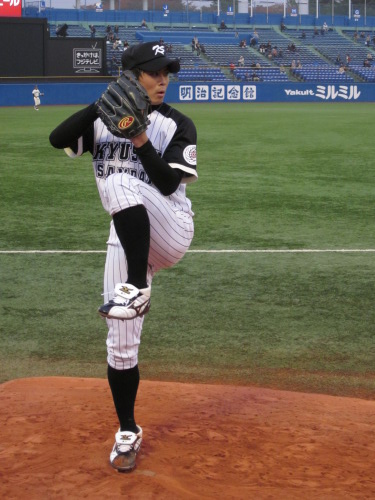
I noticed that he had a really high kick, but couldn't pick anything else out in particular about his throwing:


Anyway, Urano started off great -- the first 3 innings, he struck out 5 guys and only gave up one hit. Unfortunately, then the floodgates opened on him in the bottom of the 4th; with one out Koji Udaka singled, Toshiki Yamada also singled, moving Udaka to third... fortunately a Yuki Jihiki squeeze bunt completely FAILED after that and Udaka was out at the plate. But Hiroki Matsunaga walked, which loaded the bases, and then Daisuke Ichimaru hit a bases-clearing double to left which made it 3-0.

As for Saitoh, well, he only had one time where Aichi even got more than one runner on the bases in the same inning, and that was when they managed to load the bases off him in the 6th on a single, an error, and a walk... and he worked his way out of the jam with a strikeout and a groundout, and then came out of the game so Yuya Fukui could finish out the final 3 innings anyway. (The luxury of having more than one ace pitcher for these tournaments.)

Though Saitoh also had a somewhat bonehead moment on the bases in the 5th inning; he led off the inning with a double to left, which had the entire stadium oohing and ahhing over how "Yu-chan is also such a good batter!" And then Shohei Habu bunted him up to 3rd... except that Saitoh didn't run. No, seriously. I have no idea why, and even "Bob", the third base coach (really Shoji Nozaki, long story there), was waving him and looking confused.

So Waseda didn't add a run there, but they did add one a little later off Aichi's reliever Ogiwara in the 8th inning; Hiroki Matsunaga singled, stole second, advanced on a grounder, and was then batted in by a pinch-hitting Keisuke Sakuraba. 4-0.


Boring game, really, overall. At least the AGU ouendan was entertaining; it's always interesting for me to see and hear new marching bands and cheer routines, and the non-traditional approach was kind of refreshing (but don't get me wrong, I love gakuran jackets and the ouendan boys in Big 6 too).

Anyway...

The fourth game of the day was Kyushu Sangyo University (representing Kyushu) vs. Kokugakuin (representing the Tohto League). Now... I do not have the stamina to do three full games, especially by myself, so I was not planning to stick around for the entirety of this game. I even already had dinner plans with two friends who were moving back to the US this week.

HOWEVER, Kyushu Sandai's starter was Yodai Enoshita, and he just got drafted by the Fighters two weeks ago, so I just HAD to run down to the bullpen to watch him warm up and take a few photos. Plenty of other people had the same idea too, but I was able to get right up there against the netting and watch him throw.

I stuck around for the first few innings of the game before leaving for dinner. Enoshita did eventually get the win. I like him quite a bit already! Shame I won't be around next year at Kamagaya to harrass him about blowing his arm out in college like I did with Yutaka Ohtsuka, though.


Yodai Enoshita.


Well. Sorry this post took so bloody long to write. I've actually been spending this month watching a lot of non-baseball sports -- hockey, American football, and even a basketball event. The offseason still sucks, though. I did make it to the Swallows fanfest today though, hopefully I'll post a few photos from that soon. Seeing Keizo Kawashima again made it all worthwhile :)

Saturday, November 20, 2010

Nishijima Signs?

Well, it's all over the Japanese news sources but the only one I can find in English is the LA Times plus a whole bunch of people copying and pasting from that article.

I'm not really sure what to say, as I knew that Nishijima and a few other Meiji boys were hoping to find ways into playing in the US next year, so I guess I should be happy for him. Except that before this year I was a much bigger Nishijima fan than I was after this year. Long story, really. (Or more like, a lot of long stories from various players and fans, and well, Nishijima himself blew me off the time I tried to talk to him, so.)

So let's call this a Friday Foto, I suppose:


Kazuki Nishijima, in his last weekend as an undergraduate pitcher, Oct 23 2010. He pitched one inning that day, and then 10 innings the next day. And for once people were saying "he did his best" rather than "boy, he's selfish".


Kazuki Nishijima throwing between innings. September 21, 2009.

Anyway, Nishijima's certainly not a bad pitcher, he's just inconsistent at times. He won the ERA title in the Big 6 last fall, but it kind of took a lot of people by surprise. He's a big lefty dude from Yokohama HS who can hit the low 140's on the radar gun, so he certainly has potential.

But part of why I have no good pictures of him from the left side is that I'm usually at Jingu for the Saturday ace games, and Nishijima has never in his 4 years been Meiji's ace, even in his ERA crown semester. His freshman year they had Kume (now with Softbank), his sophomore year they had Iwata (now with Chunichi), and by his junior year, sophomore Yusuke Nomura had taken the ace role. I think that's always kind of pissed him off since he was such a hotshot in high school.

(Actually, this is my favorite photo I've ever taken of Nishijima because he actually looks so excited and happy, which I never really saw out of him much. This was right before Meiji won the Fall 2009 championship.)

Also, for the record, Meiji announced their 2011 Team Leaders, and I guess Kumabe wasn't kidding when he told me "It's Ikuhiro!", because, yes, the next captain is Ikuhiro Takeda, who is a little infielder that barely appears in games. (Of course, the 2010 captain, Yamauchi, was a tiny catcher who ALSO barely appears in games.) Yosuke Kobayashi, Masataka Nakamura, and Yusuke Nomura are the vice-captains. Takayuki Morita is the pitching leader, which is kinda funny, but we'll see what shakes down with Meiji's pitching staff this year anyway.

EDIT> Hey, an actual announcement on MLB.com posted a few days after I made this post, with some comments from the guy who scouted him, etc.

Wednesday, November 17, 2010

Cheering For Powerhouse High Schools

(This started as an intro to my Jingu Taikai post, but got really long so I'm splitting it out.)

People ask me sometimes why I tend to hate the big powerhouse popular superteams like the Yankees or the Kyojin or even Waseda University, but I'll still go cheer for powerhouse high school teams here in Japan like Teikyo or Nichidai Sanko or Urawa Gakuin.

The main difference really is that on the pro level, so much of what goes on is motivated by money. Less so in Japan than in the US, but let's face it, the Yomiuri Giants can actually afford to sign a host of expensive foreign players, a host of expensive Japanese players, keep a ni-gun and san-gun team effectively... which many other teams simply can't afford to do. Plus they frequently STILL have players who enter the draft refusing to play for any team but Yomiuri. And Yomiuri can also flex their media connections to put Giants propaganda all over the place, so that generations of Japanese have grown up being able to watch nothing but Giants games on TV. People here are really easily influenced by perceptions of what is popular, which is usually influenced by the media. (And which is pretty ridiculous given how many people seem conscious of the fact that 90% of the media is complete crap. This goes back to money, I suppose, where a lot of newspapers go to crazy extremes to sell more copies.)

I'm guessing that having been a Big 6 fan in the Saitoh generation may have been a little different than in other times, but again, if you say here that you like Big 6 ball, you immediately get asked about Waseda and Saitoh, because your average person -- or even baseball fan -- in Japan knows nothing else about the league, and there's this annoying mentality in Japan of "Well, why waste your time liking anything that isn't the most popular thing?" The teachers at my school can't fathom why I wasn't overflowing with delight when the Fighters drafted Saitoh. I had to explain to them that I spent 4 years with the Hosei and Keio ouendan yelling "Defeat Waseda! Knock out Saitoh!"

The thing about high school baseball is how ephemeral it is here anyway, given that high school is only 3 years, and they have the system where kids retire from their teams after only a few months of their senior year anyway. In the pros, in the NPB, a star player may stay with their team for upwards of 22 years. A college star player is going to play for their team for 4 years, or 8 semesters; you can get a LOT of championships out of a few good arms or bats. But high school? A true, rare star MAY get to go to 3 summer Koshien tournaments if they are at a really strong school and they are good enough to get on the roster as a freshman. Your average decent player at a strong baseball high school is basically going to have one year of glory, if that. So these high schools not only have an ongoing cycle every year to recruit great players to make up their team, but they also have to spend a lot of time coaching these guys to work together and bring out their full potential -- and as soon as they really come together as a team, the year ends, the 3rd-year students retire and graduate, and it's a new cycle all over again.

Also, on the college or pro level, if you follow a team that kind of sucks -- like if you support the Baystars these days, or Tokyo University -- you will still get to see them play out a full season of games. Win or lose, they have a schedule to stick to. The college teams that win certainly get to play a LITTLE more due to the national tournaments.

But on the high school level, almost all of the tournaments are single-elimination. So if you follow a team that doesn't take their baseball seriously, they are literally going to end up playing like 2-3 "real" tournament games per year, during the early rounds of the regional tournaments, in stadiums in the middle of nowhere. And for someone like me, a white female who sticks out a ton, it is pretty embarrassing to show up at them. (I'm speaking from experience. At least then it was one of my former JHS students playing, so his mother could at least vouch for me not being some fearsome invader from an alien planet.) Also, quite frankly, the lower-tier schools are often truly not worth watching; some of these schools have only 11-12 kids in their baseball club total (as opposed to upwards of 100 in the bigger schools, who have a big talent pool to select their 18-man roster from) and get killed by scores like 28-0 in their games.

And at least in the Tokyo area, there are several decent schools to follow, that are going to play in front of crowds of thousands of people at large stadiums like Jingu, or Omiya, or Yokohama Stadium, where someone like me can just kind of blend into the background. I happen to live a 10-minute bike ride from Teikyo HS and am a big fan of a lot of their graduates, so I chose Teikyo as my team. Urawa Gakuin was my team when I lived near it in Saitama, because the "Support Uragaku!" signs were up all over the place and I actually had friends who were alumni of the school.

Picking any decent school means that you'll get to go to at least a few games per season at a big stadium. This year I also started following Shutoku, thanks to one of my current JHS students, and I got to follow them all the way to the East Tokyo finals (and in a way, all the way to seeing Taiki Mitsumata getting drafted!). Along the way I also got to a lot of other good schools play, and see a wide variety of players. I certainly saw a few lopsided games, but overall, even a lot of the called games I saw were not one-sided blowouts, so much as one unlucky inning for a boy whose arm finally gave out, and the rest of the team fought back to pick up the pieces.

Another big advantage of following one of the better-known high schools is that information will be a lot more readily available about what's going on with the schools and the players. Getting even a list of who appeared in what games can be a royal pain in the neck for a lot of the regional high school games. But a school like Sanko has an actual website with player lists and game scores and photos and even box scores and whatnot, which have been really wonderful for me to follow what's going on. Urawa Gakuin also has an extensive website and a bunch of alumni websites as well.

It's really interesting watching some of these players go from high school or college to the pros or the industrial leagues and seeing how they progress. And watching a decent high school or decent college team means you'll definitely see at least one guy who catches your eye for some reason. And the amateur games are really great because most of these kids are playing their hearts out just because they love the game.

And the fan experience being what it is here too -- where the players always bow to the fans and thank them for their support, and the fans go to the games and yell together -- it feels a lot more like everybody at the stadium is part of a big group rather than completely isolated. (Even if the extent most people say to me at high school games is "Which one of these schools are you the English teacher for?")

Anyway, this is all a big lead-in to me going to watch Nihon University Connected High School Number Three, aka Nichidai San or Sanko, at the Jingu Taikai on Sunday...

Tuesday, November 16, 2010

Kagami signs!

We briefly interrupt all of our other unfinished posts in order to announce that 2nd-round draft pick and all-around nice guy Kisho Kagami signed a contract today with the Yokohama Baystars. 12 million yen base salary (which is like $150,000) and 80 million yen signing bonus, which is pretty close to what a 1st-round draft pick gets anyway. Hooray!

Unfortunately they don't seem to have assigned him a uniform number yet. Still waiting on that, though I've got the blank uniform ready to go to the local Sports Authority to have them add some numbers and letters to it. But it's still good -- no, great! -- news!

His comment? "I'm really happy to sign a contract with the Baystars. From next year, I want to fulfill the high value the team has placed on me. My goal is to become another pitcher like Kenta Maeda. I'd be lying if I said I didn't want to reach the same levels as the Waseda Big 3, so I'll be working my absolute hardest to reach my potential."

Hmm. Wonder if he'll be appearing at Searex or Baystars fanfest? And whether he'd be surprised to see me if I hunted him down? :)

I haven't had time to translate his extensive interview in the Hosei Nikkan Sports blog on draft day; if anyone actually cares that much, let me know. (My favorite comment is when they point out that he still gets to bat in the CL, and he says "Uh... I think I'll be focusing on pitching first, thanks..." He actually batted really well in Big 6 for a pitcher, BUT if you've ever seen him at the plate it's pretty funny to watch.)

(And here's another interview with him about signing his contract with Yokohama. "What do you think it's like being a fan in Yokohama these days?" "...that's hard to answer. I've been watching since I was a kid (during the 'Machine Gun Offense' days) and so these past 3 years finishing in last place, you could say I'm a little worried...")

Oh, on a really quick other Hosei-related note: I was positive that either Kota Imamura or Naoki Harada were going to be the next captain, but no, the next captain is Masashi Nanba. Harada and Imamura, along with Yusuke Hasegawa, are the vice captains... I'm really surprised, honestly. Nanba is the least captain-like of the four, in terms of personality. (Though maybe I shouldn't be too surprised being as Shuhei Ishikawa was kind of a dumbass too.) And Tomoya Mikami is Kagami's successor as Pitching Leader.

Friday, November 12, 2010

Extra Inning Games in Japan Series History

This was born out of a post to japanesebaseball.com asking what the record was for extra innings games in a Japan Series, after this insane 2010 Japan Series with the 3 extra inning games and the 15-inning tie game as well.

The Japan Series started in 1950, so this year was the 61st one, I suppose. And while extra-inning games themselves are not entirely rare -- they have occurred in 28 Japan Serieses -- MULTIPLE extra-inning games in the same Series are kind of rare, and full-length tie games are REALLY rare, there have only been 6 in all of Japan Series history (and 7 ties total ever).

So with a little research, I figured out the following. There have been 10 Japan Series with more than one extra-inning game. Here are those years, and I'm also including 1957 so that we get all the years that had tie games.

(I am not, by the way, including the 1953 2-2 tie game that was called due to rain after 8 innings, because this post is about LONG games. For the record, I think only two games in Japan Series history have been called due to weather; that one and the Hanshin-Lotte Game 1 in 2005 where the fog made it impossible to see anything.)

1962 : 4 (1 tie, 14 innings)
1992 : 4
1995 : 3
2010 : 3 (1 tie, 15 innings)
1950 : 2
1970 : 2
1975 : 2 (2 ties, Japan Series record - 13 and 11 innings)
1986 : 2 (1 tie, 14 innings)
1994 : 2
2003 : 2

1957 : 1 (1 tie, 10 innings)

Other years with one extra-inning game: 1953, 1955, 1958, 1959, 1961, 1965, 1966, 1969, 1973, 1974, 1976, 1977, 1980, 1983, 1988, 1996, 1997.

The tie game rules have changed a little over the years, too. Up until 1966, the rules were that extra-inning games went until sunset, since most games were played during the day until then (with the exception of the 1964 Series where the games were actually played at night). In 1967 the rule was introduced that the game length limits were no longer limited by sunset, but weren't limited by innings either -- they instead were determined by time: "you can't start a new inning after 5:30pm", or in the case of night games, 10:30pm.

After the 1986 Series went to 8 games following a Game 1 tie -- the ONLY series in history to go to 8 games -- a rule was introduced in 1987 stating that games would go to 18 innings up until Game 7, and after that there was NO limit on innings. In 1994, they instituted a 15-inning limit up until Game 7, which is the currently used limit.

The 1992 Seibu-Yakult Series was a really interesting one to reread as Yakult's 3 wins were ALL in extra innings and were all from home runs in the extra innings at that. Seibu won all of the 9-inning regular-length games and then won Game 7 as well when Yakult couldn't hit a walkoff homer, I guess.

Game 1 was tied 3-3 going into extras. Yoichi Okabayashi pitched the entire game for Yakult, but Seibu went with Yoshitaka Katori from the 10th on, and he gave up a walkoff grand slam to a pinch-hitting Toru Sugiura in the bottom of the 12th for Yakult to win 7-3.

Seibu won the next 3 games in the regulation 9 innings (with Daisuke Araki giving up a 2-run homer to Kazuhiro Kiyohara and losing Game 2, Kazuhisa Ishii losing game 3 to Takehiro Ishii, and Katori getting the revenge win in Game 4 over Okabayashi, who gave up a home run to Koji Akiyama).

So with Seibu poised to take the Series, the game moved back to Seibu Kyujo for Game 5, where it went into the 10th inning tied 6-6, and Takahiro "Bun-Bun Maru" Ikeyama hit a homer off Seibu closer Tetsuya Shiozaki to put Yakult ahead 7-6 and win the game.

Game 6 found them back at Jingu, and in this case, they found themselves in the 10th inning with the score tied 7-7. This time, the game ended when Shinji Hata hit a walkoff homer off Tetsuya Shiozaki to win the game 8-7, and tie the Series at 3 games apiece.

Game 7 featured Okabayashi facing off against Takehiro Ishii, and yet again the game went into extra innings. Seibu put up a run in the top of the 10th on a sac fly, Yakult couldn't match it, and that's how Seibu won the 1992 Japan Series.

(Hisanobu Watanabe, current Lions manager, started Games 1 and 5 and came out of neither with anything to show for it.)

Tuesday, November 09, 2010

Iwakuma to Oakland, huh

A's win bidding for Japan's Iwakuma

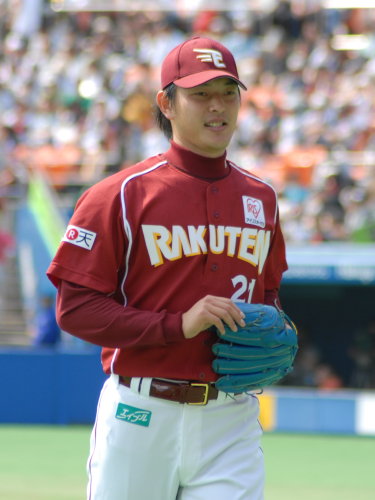
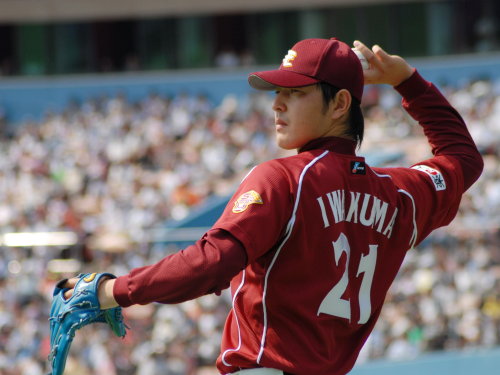
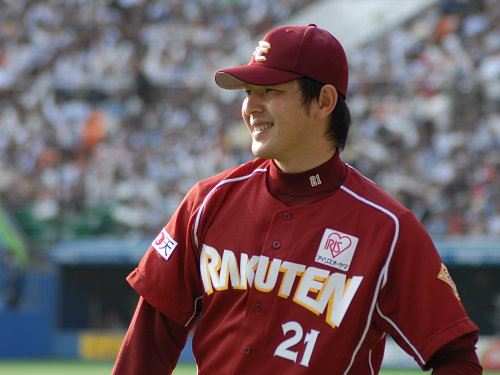
When I took my barnstorming trip through Hokkaido and Tohoku this August, that I never had time to write about here, one of the funniest moments of the trip was when I went to catch the shinkansen home from Morioka. I went to get a bento in the station and thought that there were some really big guys ahead of me in line... and then realized that they were Hisashi Iwakuma and Takeshi Yamasaki. No joke. The entire Rakuten Eagles team was taking the same train as me. Sure, they were wearing white button-down shirts and slacks, which is normal travel attire for ballplayers, but some of those guys are pretty easily recognizable.

Of course, I was carrying my huge Fighters duffel bag with me at the time, being as I'd just gone to 4 Fighters games in 3 different prefectures over the span of 5 days, and taken the train to all of them. And I felt pretty ridiculous-looking, as a big gaijin running through the train station carrying a bunch of crap, and I even think a few of the players were laughing at me. So I didn't say anything to any of them.

Now I feel pretty stupid for that -- I could have at least asked for a photo with Hisashi Iwakuma and gotten shot down...

Anyway, being as this is Marinerds, this is not a post about how fast he throws the ball, or about how he completely redid his pitching motion a few years back or any technical stuff. Sorry. I just have some cultural notes and some photos to share, as usual.

First off, for those who learned Japanese from videogames and anime, and do correctly know that "kuma" is the word for "bear", it isn't the same kuma kanji that is in his name. 熊 is bear. Hisashi Iwakuma's last name is 岩隈, and THAT kanji 隈 that can be pronounced "kuma" actually means shadow, so his name pretty much means "the shadow from a large rock", which is pretty appropriate as Iwakuma's a really tall guy and casts a pretty big shadow.

Though, when he signs stuff he signs as "Kuma" in English. (You can see some examples if you Google on "Iwakuma signature" in Japanese. It looks like he used to sign in Japanese a REALLY long time ago, but switched to an English signature in recent years.)

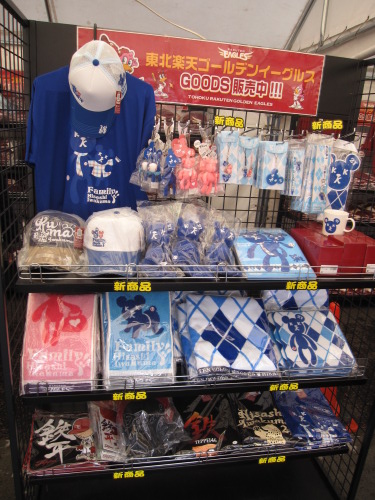
This year, when Rakuten made "player-produced" lines of merchandise, like t-shirts and towels and pens and such, each player in the promotion was supposed to pick an animal and a theme for their merchandise. (I talked about it a bit back here.) This is what the Iwakuma merchandise rack looked like:


The theme being "family", and as such, the animal avatar being a baby bear, since he has two young children, and it's a play on the word "kuma", which if you hear it on its own, could have several different meanings. (Japanese is fun that way.) Iwakuma's blue glove is one of his trademarks, so the majority of the "kuma" merchandise is a blue baby bear.

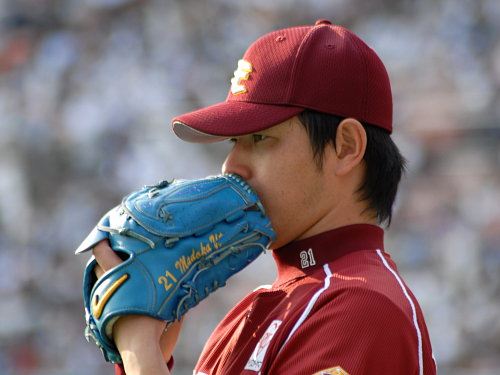
Iwakuma's wife is named Madoka, and she happens to be the daughter of Koju Hirohashi, former Seibu infielder and coach, now a Rakuten coach. Iwakuma also has his wife's name embroidered on said trademark blue glove:


(I took this photo of him on May 9 2009, at Chiba Marine Stadium. It was actually hard to get a clear shot of the glove. I have a few more photos of him in this post.)

And in the meantime, he and his wife also do charity work to support orphanages and children with disabilities.

I've been an Iwakuma fan for a few years. He's hard not to like; a family guy who works hard at his job and is really good at it. And for ages and ages he was in the shadow of so many other guys here, and just kind of modestly accepted his position. (This was especially true when he was robbed of the WBC 2009 MVP award.)

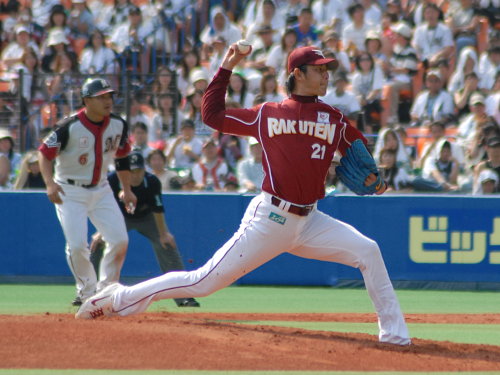
Anyway, here are a few other photos from that May 2009 game where I was lucky enough to be in the camera well at Chiba Marine Stadium thanks to Bobby Valentine and Larry Rocca being the most awesome guys on the face of the earth:


(The guy in the background, btw, is Iguchi. On the last shot, it's Ohmatsu.)


Seriously, I pretty much only went to Chiba that day to watch Iwakuma and take photos of him. I'm glad I did. He was awesome.

And one more reiteration of a funny shot from when Lisa and I were hanging out in Sendai a few years ago before a Fighters game. She's actually a Rakuten and Lotte fan, and loves both Ma-kun and Iwakuma, but when we were going around taking silly photos around the stadium, we saw these cardboard cutouts of Iwakuma and Ma-kun and just HAD to do this one...


Sadly, I suppose that is the closest I'll ever get to taking a photo with Iwakuma himself, unless I do a good job of stalking him after I move back to the US this winter. I do have an Iwakuma #21 t-shirt, so you may see me wearing it around Safeco Field next summer when the A's come to town...

Monday, November 08, 2010

Recipe For A Lotte Japan Series Championship

I was just thinking about the 2005 Japan Series again, since that was the first one I really followed every game for. As such, I have come to the conclusion that the following things are required for Lotte to win the Japan Series:

- a difficult weather phenomenon during Game 1 (2005: ridiculous fog that eventually stopped the game in Chiba. 2010: a typhoon hitting the eastern seaboard of Japan during Game 1, but it was in a dome)

- a Korean 1B/DH who first earns the ire of the Lotte fans but comes through in the postseason and gets back into everyone's good graces (2005: Seung-Yeop Lee, 2010: Tae-kyun Kim.)

- Shunsuke Watanabe throwing at least one complete-game win (2005: Game 2, 2010: Game 3)

- a closer named Kobayashi who blows at least one save in the postseason (2005: Masahide, 2010: Hiroyuki)

- a foreign pitcher to surprise everyone with a start (and win!) in Chiba (2005: Dan Serafini, 2010: Hayden Penn)

- Toshiaki Imae coming through in clutch situations and winning an MVP

- The opposition putting up an ancient lefty pitcher as a starter (2005: Tsuyoshi Shimoyanagi, 2010: Masahiro Yamamoto)


I'll add to this as I think of more -- or feel free to chime in yourself!

Oh, for the record, I bought a ticket today for the SK Wyverns vs. Chiba Lotte Marines game this coming Saturday. If you're thinking of going, I suggest jumping on tickets soon -- the Lotte fans are going to fill the Tokyo Dome, I think. (I'm expecting they'll have to sell a lot of IF unreserved tickets and open up the 2nd floor, honestly.)